
DISC selling means adapting how you pitch, ask questions, and close based on a buyer’s behavioral style — Dominant, Influential, Steady, or Conscientious — instead of running the same script on every call. It works because buyers don’t just evaluate what you say; they evaluate whether the pace, tone, and level of detail match how they naturally process a decision. Get that match wrong and a technically perfect pitch still falls flat.
What Is DISC Selling and Why It Works
DISC is a behavioral framework built around two axes: how direct or reserved someone is, and how people-focused or task-focused they are. Cross those axes and you get four styles — Dominance, Influence, Steadiness, and Conscientiousness — each with a distinct way of making a buying decision. A rep who treats every buyer identically is optimizing for the rep’s comfort, not the buyer’s. DISC selling flips that: the message stays consistent, but the delivery, pacing, and proof points shift to match the person on the other end of the call.
This isn’t a personality test you administer before a deal. In practice, DISC selling means picking up on behavioral signals — how fast someone talks, how many questions they ask, how much small talk they tolerate and adjusting in real time. Reps who do this well aren’t more scripted. They’re more observant.
The Four DISC Buyer Types
Each style wants a different version of the same conversation:
- D — Dominance: Direct, results-driven, impatient with detail. Wants the bottom line first, hates a slow build-up, and will interrupt to skip ahead. Lead with outcomes and ROI, keep the deck short, and let them drive the pace.
- I — Influence: Enthusiastic, relationship-first, decides on energy and story as much as data. Wants to feel a connection with the rep before the numbers matter. Lead with a narrative or a peer example, and don’t rush past the rapport-building.
- S — Steadiness: Patient, risk-averse, values stability and trust over speed. Wants reassurance that this won’t disrupt their team and that support will be there after the sale. Lead with process, implementation detail, and low-pressure pacing.
- C — Conscientiousness: Analytical, detail-oriented, skeptical of claims without evidence. Wants data, methodology, and answers to the question before they ask it. Lead with specifics, case studies, and be ready to show your work.
How to Spot a Buyer’s DISC Type on a Call
Most reps never get a buyer to fill out a personality assessment, so the type has to be read from behavior in the first few minutes. A few reliable tells: how quickly they get to the point (D and C move fast, I and S ease in), how much they talk about people versus process (I and S lean people, D and C lean task), and how they respond to being interrupted or challenged (D pushes back immediately, S tends to go quiet). Question style is another signal — a buyer who asks “how fast can we start” is behaving differently than one asking “what happens if this breaks in month six.”
None of these signals are definitive on their own. The skill is triangulating two or three of them quickly enough to adjust before the buyer decides the conversation isn’t for them.
Where DISC Breaks Down in Real Sales Conversations
DISC’s limitation isn’t the framework itself — it’s that most sales orgs treat it as a static label instead of a live read. A buyer typed as “C” from a LinkedIn profile or a company’s industry doesn’t behave like a C on every call; a rushed exec under deadline pressure can show D behavior even if their baseline is S. Buyers also blend styles depending on what’s at stake in the specific decision, and a multi-stakeholder deal usually means reading several different styles in the same call, not one.
This is also why DISC training that stops at a workshop rarely changes behavior. Knowing the four types in theory doesn’t help a rep who’s three minutes into a live call and hasn’t yet placed which one they’re talking to. The gap isn’t knowledge, it’s real-time recognition under pressure — the same gap that shows up in most sales coaching problems.
How Dextego Adapts to Buyer Style in Real Time
Dextego’s AI Sales Coach, Tego, builds this kind of behavioral read automatically instead of leaving it to a rep’s instinct in the moment. Before a call starts, Tego scores communication compatibility between the rep and the buyer using public signals and CRM history — the same underlying idea as a DISC read, but generated from actual data rather than a guess based on job title or industry. That profile then shapes what shows up on the rep’s screen: a faster, outcome-first script for a direct buyer, or more detail and reassurance surfaced for a buyer who needs to see the process before they trust the outcome.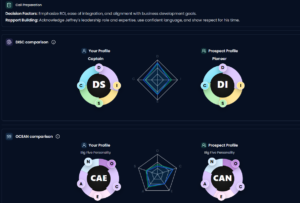
During the call, Tego keeps adjusting as the buyer’s actual behavior comes through — a buyer who starts fast and detail-averse but slows down and starts asking process questions gets a different set of prompts than the one Tego expected at the start. That’s the piece a workshop can’t deliver: the read updates live, on this call, with this buyer, instead of relying on a type a rep memorized weeks ago and half-remembers under pressure.
Frequently Asked Questions
What are the four DISC personality types in sales?
Dominance (direct, results-driven), Influence (relationship-driven, enthusiastic), Steadiness (patient, risk-averse), and Conscientiousness (analytical, detail-focused). Each type makes buying decisions differently, so the most effective reps adjust pacing and proof points to match.
How do you identify a buyer’s DISC type without a formal assessment?
Watch behavior in the first few minutes: how fast they get to the point, whether they lead with people or process questions, and how they react to being challenged or interrupted. These signals are reliable enough to adjust an approach mid-call.
Does DISC selling mean changing the sales pitch itself?
No. The core message and value proposition stay the same. What changes is the delivery — pacing, level of detail, and whether the conversation leads with outcomes, relationship, process, or data.
Is DISC still relevant with AI sales coaching tools available?
Yes, but the application has shifted. Instead of a rep memorizing four types from a workshop, AI coaching platforms like Dextego’s Tego generate a live compatibility read from actual buyer behavior and data, then surface the right adjustment in the moment rather than relying on recall.
What’s the biggest mistake reps make applying DISC in real calls?
Treating a buyer’s type as fixed instead of live. A buyer’s behavior shifts based on context, stakes, and who else is in the room, so a read taken once before the call often doesn’t hold for the whole conversation.
See Real-Time Buyer Adaptation in Action
Book a demo and we’ll show you how Tego reads buyer communication style live and adjusts a rep’s coaching on the call, not after it.